
Help you to keep track of your risk and to handle it
In TOSCA, the risk register concept led to the development of a web based application for SMEs aimed at achieving the full benefits envisioned. The software provides the possibility to screen all company operations and assets for risks and devise a plan to mitigate or prevent the scenarios, ensuring the capacity of the company to manage business continuity. It allows the use of participatory risk analysis of company processes and procedures, allowing risks identified and analysed around process mapping to be transferred automatically to the risk register. The final software also includes dashboards for easy top-level visualisation of risk status and full realisation of benefits.
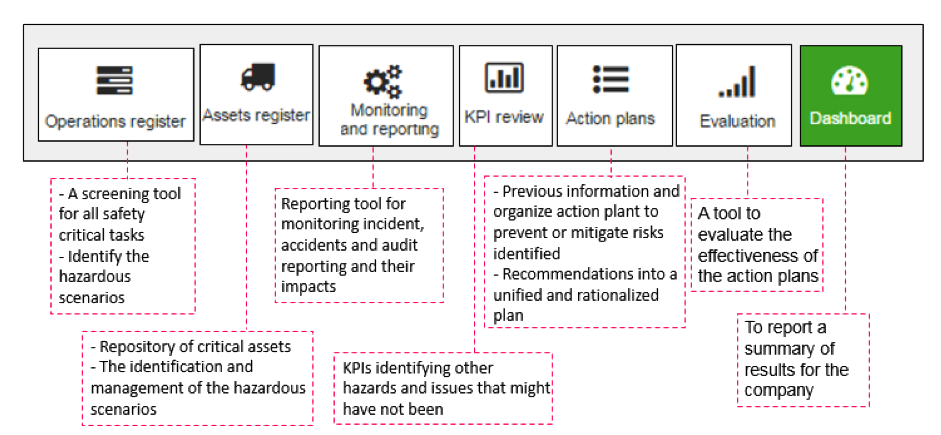
It is composed of different modules that can also be used as stand-alone tools, and as a step by step guide to the building blocks of a complete risk register:
 An operations register to be used as a repository and screening tool for all safety critical tasks in the company, identifying the hazardous scenarios related to those.
- An assets register of the company, working as a repository of critical assets and the identification and management of the hazardous scenarios related to those.
- A reporting tool for monitoring incidents, accidents and audit reporting, and their impacts on company KPIs, identifying hazards and issues that might not have been covered in the hazard identification performed on operations and assets.
- A module to organize and query the previous information and organize action plans to prevent or mitigate the main risks identified, aggregating different scenarios and recommendations into a unified and rationalized plan. This also covers plans to ensure business continuity.
- A tool to evaluate the effectiveness of the action plans.
- A dashboard to report a summary of results for the company against relevant KPIs.
The benefits of implementing Risk Register TOSCA
- The ability to compare technical and non-technical risks.
- Providing visibility of risks and a quick reference point for targeting investment.
- Aligning risks with internal and external norms.
- Placing risk management alongside performance management and making it part of management discussions.